

Poser Culture: What Copying Carolyn Bessette's Style Says About Fashion Right Now

Lawrence Schwartzwald//Getty Images
There's a scene that plays out on social media almost every day now. Someone films a flat lay of cream-colored basics, a structured blazer, a pair of ballet flats, a tortoise headband, and a quiet, understated handbag — and captions it something like "channelling my inner CBK." Since Ryan Murphy’s Love Story brought Carolyn Bessette to our screens on FX, her wardrobe has been dissected, recreated, and shopped to death in the matter of a few weeks. The tortoise headband. The slim, oval-framed sunglasses. The ballet flat in precisely the right shade of nude. Within weeks of the show airing, TikTok was flooded with "Carolyn Bessette inspired" hauls. Pinterest boards multiplied overnight. The algorithm latched on, as it always does, and suddenly everyone had an opinion on quiet luxury, old money aesthetics, and the precise shade of oatmeal that best captures her essence.
Here is the thing though — what made Carolyn's style so quietly devastating had nothing to do with the clothes themselves. It had everything to do with the fact that they were hers.
The Problem With Copying a Character
Carolyn Bassette was not trying to be anyone. That is the whole point. The reason her look resonated so deeply is because it felt like an extension of her — considered, unhurried, completely unbothered by whether it was trending. The restraint was personal. The palette was personal. The refusal to over-accessorise, the way a coat fell just so — none of it was constructed for an audience. It simply was.
When you strip that away and reduce it to a shopping list, you lose the only thing that actually mattered. A cream ribbed top is a cream ribbed top. On Carolyn, in context, it said something. Pulled from a Zara haul and styled by someone who had never worn anything like it before last Tuesday, it says something entirely different — and that something is that you have seen a character on television and decided you want to inhabit their identity.
That is not inspiration. That is cosplay without the self-awareness.
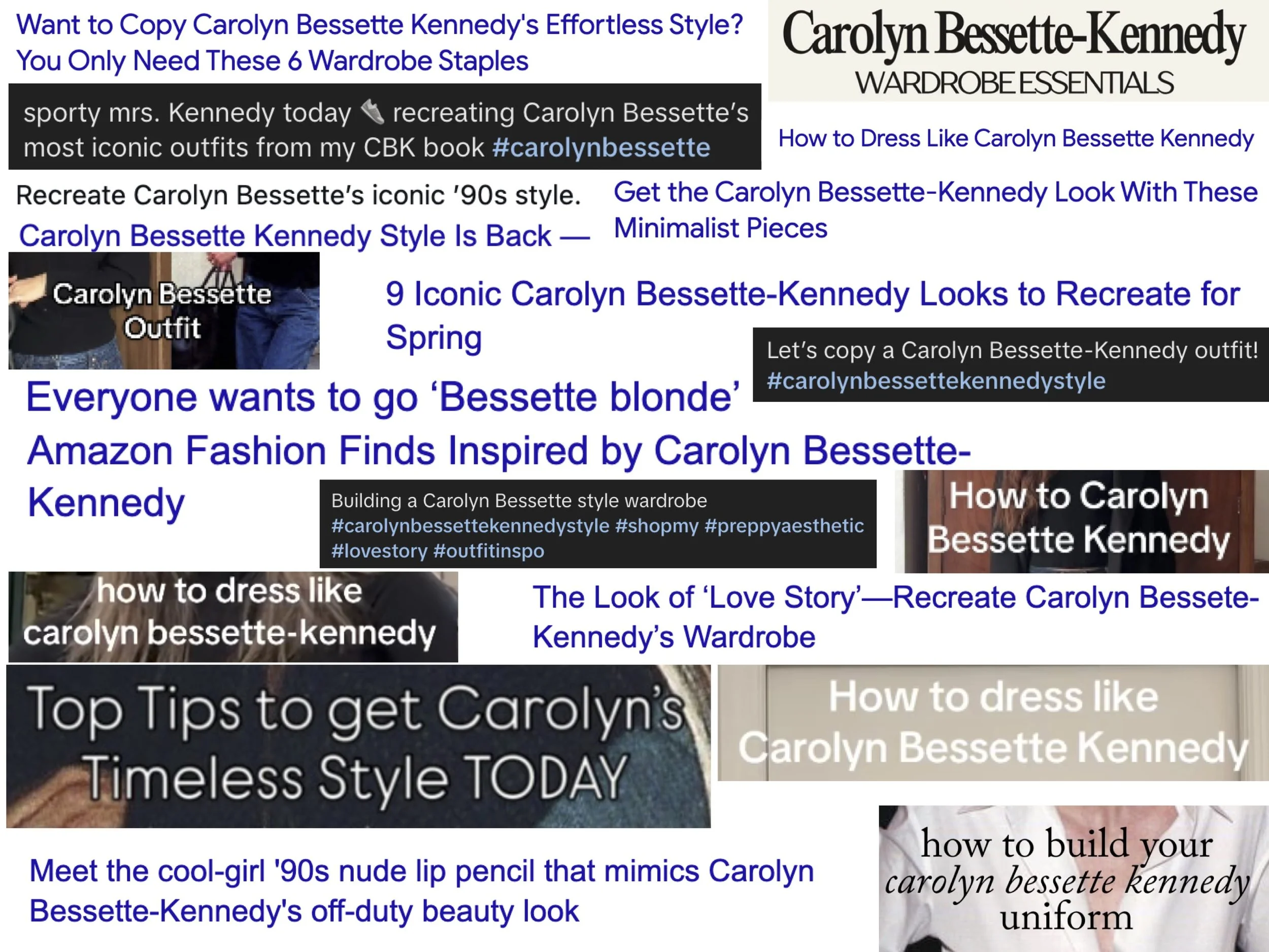
A quick search tells you everything you need to know.
Poser Culture and the Influencer Machine
What is accelerating all of this is the influencer ecosystem that surrounds it. We now live inside a content loop where someone with a following films themselves unpacking a parcel, holds up a linen blazer, says "obsessed, this is so Carolyn Bessette," drops a link in the bio, and tens of thousands of people go out and buy the exact same blazer before the week is out. None of them have stopped to ask whether they actually like linen blazers. Whether they would reach for one on a Sunday morning unprompted. Whether it suits how they actually live.
They bought it because a person on a screen — a person who is being paid to say "I love this, you need this" — told them to. And in doing so they did not develop a single inch of personal style. They outsourced the entire process.
This is Poser Culture — a term that has existed in subcultures like punk and metal for decades, used to describe someone who adopts the look without any connection to the substance beneath it. A poser wears the band shirt but has never heard the album. They buy the aesthetic without buying into what created it. The term has always carried a slightly harsh edge, and honestly, some of that harshness is warranted here. Because what is happening with Caroline Bessett's style is exactly this dynamic, just repackaged for the algorithm age. It is not about being fake, exactly — most of these people genuinely believe they love what they are buying in the moment. It is about the absence of any internal reference point. Style becomes a series of reactions to external stimuli rather than a conversation with yourself. You are not dressing from the inside out. You are dressing from the FYP inward.
Influencer culture has monetised this loop and made it seamless. The gap between seeing and buying is now measured in seconds. There is no sitting with something. No asking yourself whether it aligns with anything you already own, already love, or actually reflects who you are. Just frictionless consumption, dressed up as self-expression.
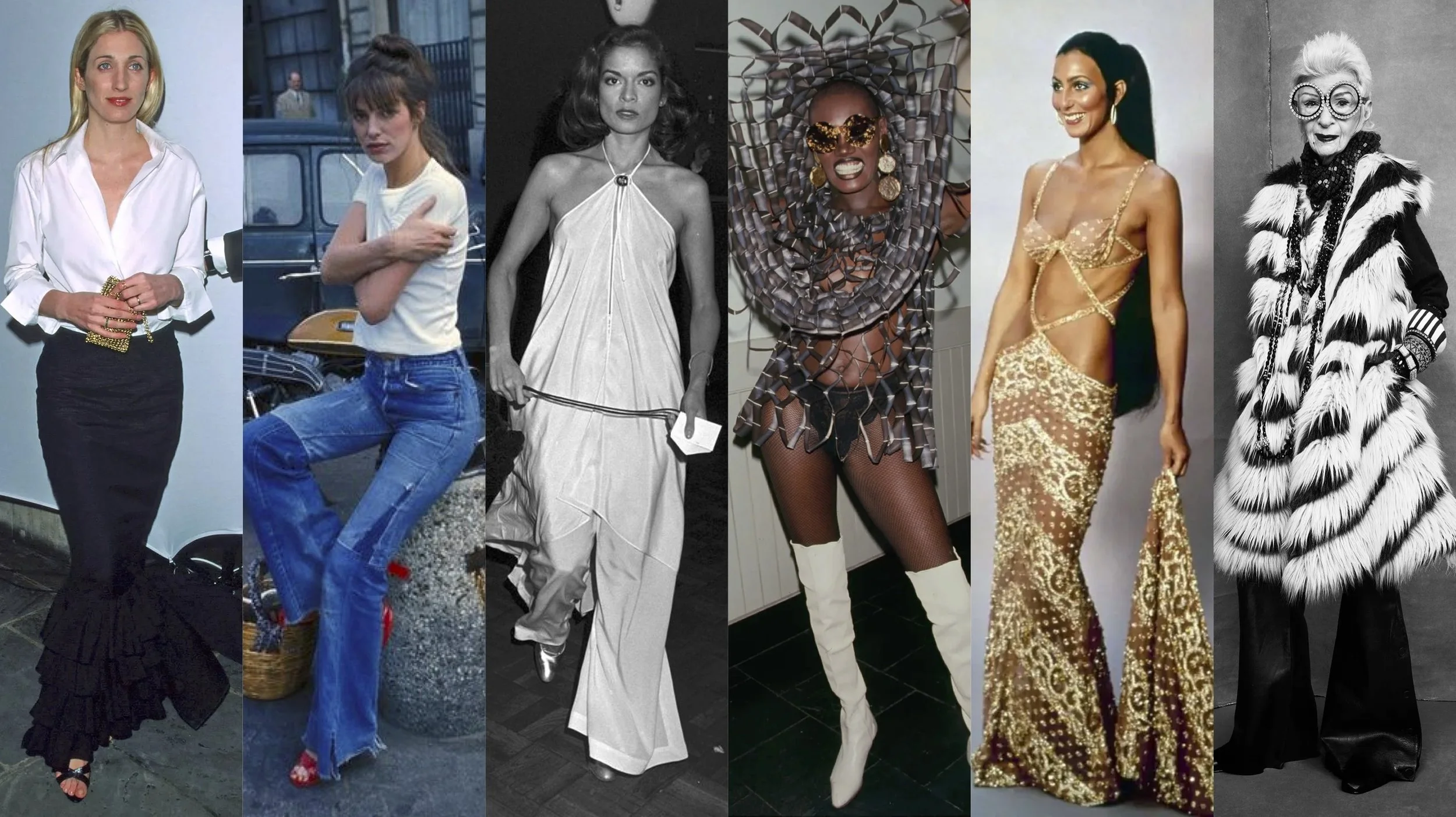
Pictured from left to right: Carolyn Bessette, Jane Birkin, Bianca Jagger, Grace Jones, Cher, Iris Apfel.
But Inspiration Is Not the Enemy
I want to be careful here, because there is a version of this conversation that tips into snobbery — the idea that looking to others for fashion direction is somehow shallow or lazy. It is not. Looking outward is part of how style develops. The issue is what you do with what you see.
And I say this as someone who has absolutely bought something because I saw it on an influencer or a celebrity and simply had to have it. I do not think that is something to be ashamed of. There are countless people — designers, creatives, public figures — whose taste I genuinely admire and who have pointed me towards things I might never have found on my own. Seeing a piece styled beautifully on someone whose eye you trust can be a completely legitimate entry point. That is just how visual culture works, and pretending otherwise would be dishonest.
The line, for me, is when it stops being a starting point and becomes the whole journey. When your wardrobe is essentially a curated collection of other people's personalities — assembled from affiliate links and sponsored posts — rather than a reflection of your own, that is when something has gone wrong. There is a difference between being influenced and being dependent. One is a conversation with the world around you. The other is an abdication of self.
In my own approach to getting dressed, I have always turned to designers and icons — past and present — as a compass rather than a blueprint. The way Helmut Lang built rigour into simplicity. The clean pragmatism of early Jil Sander. The way certain women — Carolyn Bessette-Kennedy, Jane Birkin, Bianca Jagger — wore clothes as though they had simply put on what was already in their wardrobe, without ceremony or self-consciousness. But then there is the other end of the spectrum, and I find it just as instructive. Grace Jones. Cher. Iris Apfel. People for whom fashion was never quiet, never understated, never remotely effortless-looking — and yet every single one of them was undeniably, completely themselves. The maximalism, the eccentricity, the refusal to be anything other than exactly what they were — that is not trying too hard. That is the purest form of self-expression there is. It just looks different. What all of these women share, whether they wore a basket bag and a basic tee or a sculpted Mugler bodysuit, is that their clothes were an outward extension of their soul. You could not imagine them dressing any other way. I constantly look at all of these references. But what I am always asking is: what does this tell me about myself? Not: how do I replicate this?
That distinction is everything.
Fashion as a Linear Conversation
The way I think about clothing is linear. Fashion does not move in circles so much as it moves in a long, continuous line — and if you look along that line, you see the same pieces surfacing again and again. The trench coat. The wide-leg trouser. The simple pointed flat. The striped shirt. The oversized blazer. These are not trends. They are the load-bearing walls of a wardrobe, and they return to the runway season after season because they answer something real and enduring about how people want to move through the world.
One of my favorite things to do is sit with fashion history — pulling up vintage runway archives, watching old shows from the 90s and early 2000s, going back further to the structured elegance of the 60s or the fluid minimalism of the late 70s. What strikes me every time is how much of it still feels completely relevant. A Helmut Lang show from 1998. An early Calvin Klein collection. Azzedine Alaïa's work from any decade. These are not relics — they are a masterclass in the clothes that endure, and why. When something keeps reappearing on the runway across thirty or forty years, it is telling you something. It is not a coincidence. It is a piece that works at the level of proportion, practicality, and human anatomy, and no amount of trend cycling will make it obsolete.
This is my primary source of inspiration, and it has completely changed how I shop. Rather than looking at what is in stores right now or what everyone is wearing this season, I ask myself whether I have seen this silhouette or this piece return again and again throughout history. If the answer is yes, it earns its place. If it only exists in the context of right now, I am deeply suspicious of it.
When I shop with this in mind — looking for the pieces that have stood the test of time, that keep reappearing because they work — I am not chasing anything. I am building something. And that is the alternative to the micro-trend treadmill that social media would have us all running on indefinitely.
Micro-trends, by their very nature, are designed to expire. They are born out of a moment — a show, a character, a viral post — and they are dead before the season is out. The people who spent forty dollars on a Carolyn Bessette-inspired ballet flat in a specific shade of greige that was everywhere six months ago are already being told by the same influencers who sold it to them that it is over. And the tortoise headband — the one no one warned them would squeeze so tightly behind the ears it gives you a headache by noon — has already been tossed to the back of a vanity drawer, never to be worn again. On to the next thing. Keep scrolling. Keep buying.
The clothes that last — in your wardrobe and in fashion history — were never part of that conversation.
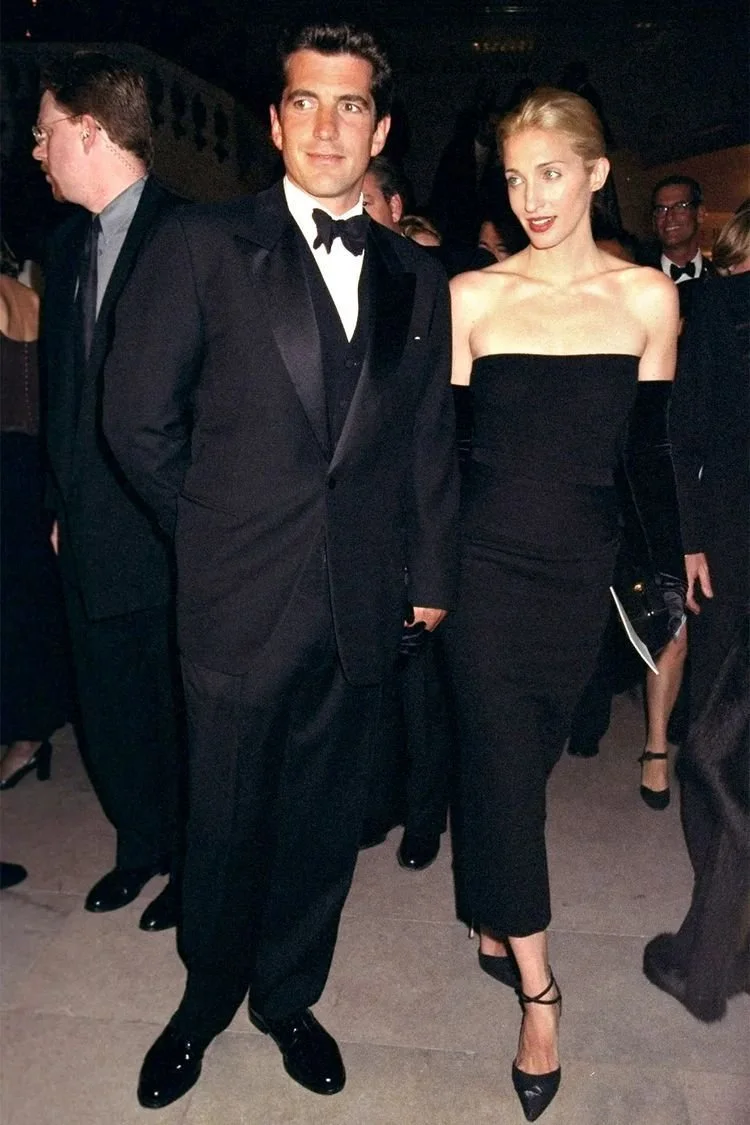
Richard Corkery/NY Daily News Archive via Getty Images
Wearing Something Because It's Yours
I think about Carolyn Bessette's style, and what I actually take from it is not a color palette or a silhouette. It is the attitude. The apparent indifference to whether anyone else approves. The sense that these choices were made privately, for reasons that have nothing to do with being seen.
Look at the details. No jewelry. No visible logos. She reportedly went as far as removing the Prada logo from a ski suit she had purchased — a deliberate, personal choice that said everything about how she related to clothing and nothing about what she wanted you to think of her. We do not fully know why she made these choices. We were not supposed to. That is precisely what made them so compelling. They were not statements designed for an audience. They were just hers.
And that is the part that gets completely lost in translation when people try to copy her. You can buy the ballet flat. You can source the headband. You can remove every logo from every item you own in some kind of wholesale tribute. But you will not arrive at what she had, because what she had was not a set of rules — it was a relationship with herself. Those choices made sense for Carolyn. They do not automatically make sense for you, and there is something slightly hollow about adopting someone's most personal, idiosyncratic decisions as though they were simply the next item on a shopping list.
That is worth aspiring to. But you cannot get there by copying. You get there by doing the slow, sometimes frustrating work of figuring out what you actually like — not what the algorithm has decided is having a moment, not what an influencer is being paid to shift, not what a fictional character wore in episode three. What you like. What makes you feel like yourself when you put it on.
That process takes time, and it requires a certain resistance to the noise. It means scrolling past the hauls and the "get ready with me" videos and asking harder questions. It means buying less and wearing more. It means looking at a beautiful coat on a beautiful woman — fictional or otherwise — and letting it spark something personal rather than simply opening a new tab.
Caroline Bessett's style was great because it was hers. Yours will only be great when it is genuinely yours too.
